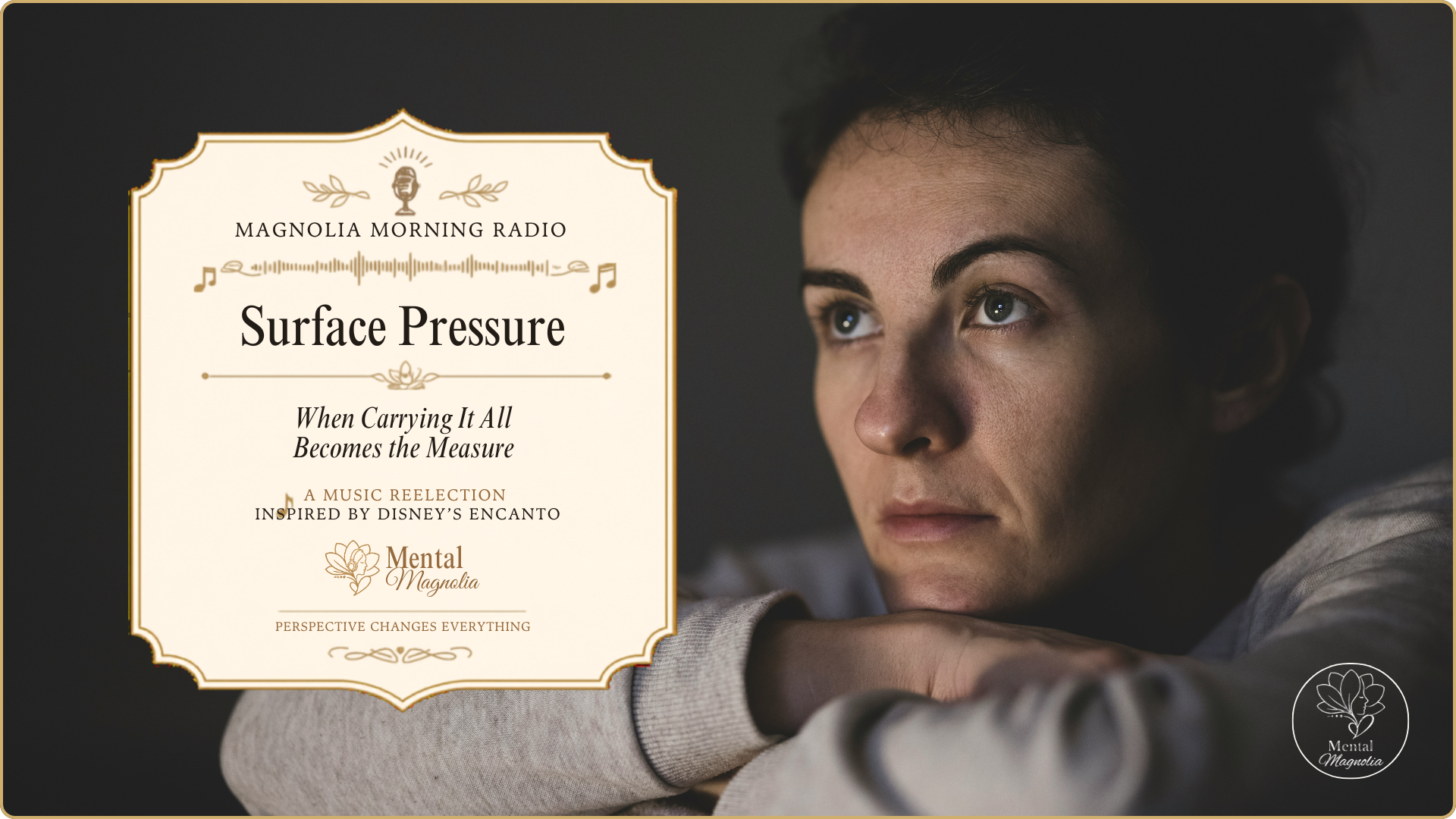
There is a question near the beginning of Surface Pressure from Disney’s Encanto that tells us exactly what’s underneath all of Luisa’s strength:
“Who am I if I can’t carry it all?
If I falter…”
The song then spends the rest of its time showing us why that question matters.
Luisa carries weight. Expectations. Responsibility. The certainty that she is the strong one and therefore the one who can take just a little more. But the pressure isn’t only coming from what she has to do. It’s coming from what being able to do it has come to mean about who she is.
Now Playing
“Surface Pressure” — Encanto
Performed by Jessica Darrow
Written by Lin-Manuel Miranda
Listen first, then come back and look again.
That question changes everything. Because now we’re not just talking about how much someone is carrying. We’re talking about what carrying has come to mean.
Maybe being dependable became part of how you understand yourself. Maybe you’re the one who remembers what everyone else forgets. The one who handles the paperwork. The one who notices the problem before it becomes an emergency. The one who keeps everyone steady. The one who figures it out. The one who can take one more thing because, somehow, you always have.
Sometimes that happens because other people recognize that we’re capable and begin relying on us. But sometimes nobody hands us the responsibility at all. Sometimes it just belongs to us. A child needs care because we’re their parent. An aging parent needs help because we love them and we’re the person who’s there. A spouse becomes sick. A family changes. A job has to be done. A bill has to be paid. Something happens that doesn’t offer us a neat little menu of choices. We carry because the thing genuinely needs carrying. That distinction matters.
There’s a version of this conversation that says, “You don’t have to carry everything. Ask for help. Set boundaries. Let things go.” Sometimes that is exactly what someone needs to hear. And sometimes it isn’t useful at all. Because some things really are ours to carry.
The more interesting question may be: What happens when carrying what is ours slowly convinces us that everything else must be ours, too?
That line can become surprisingly hard to see. If I’m responsible for this, maybe I should also anticipate that. If I know this problem could happen, maybe I should prevent it. If there’s something I could do now that might make the future safer, maybe I should already be doing it. If I have the ability, the knowledge, the experience, or the strength to take care of something, maybe not taking care of it means I’m being careless.
Suddenly possible starts turning into required. That’s where pressure gets sneaky. It doesn’t always arrive carrying a giant box labeled TOO MUCH. Sometimes it arrives one reasonable responsibility at a time. One more thing worth remembering. One more precaution worth taking. One more task that really would be helpful. One more problem you technically could solve. One more future you could prepare for.
Until eventually you are not asking whether something matters. You’re asking yourself why you haven’t already done it.
I know that voice.
It’s especially loud for me as Ry’s mom. Ry is my adult son. He’s non-verbal and severely autistic. Caring for him isn’t a responsibility somebody handed me because nobody else wanted it.
I’m his mom. Of course I carry it.
But being his mom also means knowing things about him that other people don’t. I know his rhythms – his behaviors. The things that upset him. The things that calm him. The tiny changes that tell me something may be wrong when he can’t simply explain it to me.
One of my greatest fears is what happens when someday I’m no longer here to know those things.
So there are things I know I need to think about because his future genuinely matters. There are protections that need to exist. Plans that need to be made. Questions about care, money, services, safety, and who will understand him when I’m no longer the person standing beside him. Those are not imaginary responsibilities.
But there are also limits. Limits to money. Limits to time. Limits to energy. Limits to how many future possibilities one person can prepare for while still taking care of what’s happening today.
And yet the thought still finds its way in: If there’s something I could do to make his future safer and I haven’t managed to do it yet, am I failing him?
That is a heavy question and I don’t think caregivers are the only people who ask some version of it. Maybe yours sounds like:
If I had saved more….;
If I had noticed sooner…
If I had made a better plan…
If I were more organized…
If I could just keep up…
If I had enough energy…
If I were stronger…
Then maybe I could finally make everything safe. Maybe I could prevent the mistake, the illness, the financial problem, the disappointment, the emergency, the thing I’m afraid will happen if I stop watching for it.
There is love in some of that vigilance. There is responsibility in it. There can also be fear. And the trouble is that those things can live in the same place. So I don’t think the answer is simply to loosen our grip.
Before we tell ourselves to put something down, perhaps we need to look at what is actually in our hands.
Does this need to be carried?
Does it need to be carried now?
Does it need to be carried by me?
Does it need to be carried this way?
Could part of it be shared?
Could part of it wait?
And perhaps the hardest question: Am I carrying this because it ‘s truly my responsibility, or because I’m terrified of what it would mean if I couldn’t handle it?
There is a difference between saying, “I can carry this,” and “I must carry all of this.”
There is also a difference between, “This matters,” and “This must be accomplished today.”
I’m learning that one slowly. I don’t quit easily. Sometimes that’s one of my strengths. Sometimes it means I keep adding weight long after my arms have started shaking. So lately I’ve been trying something that sounds much smaller than “letting go.” I’m trying to slow down. To let not now actually mean not now instead of turning it into failure. To recognize that something can remain important even if I don’t have the capacity to carry it today. To remember that reducing the amount I’m carrying at one time is not the same thing as abandoning what matters.
Maybe strength isn’t measured by how long we can keep adding weight without breaking. Maybe sometimes strength is knowing enough about the load to decide what actually belongs there. Because being capable of carrying something doesn’t automatically mean it was meant to be carried alone. And being unable to carry everything doesn’t mean we have failed at carrying what matters.
Look Again
So perhaps the question for this week isn’t: What can you put down?
Maybe it’s: What are you carrying, why are you carrying it, and what do you believe would happen if you stopped?
We can start there. Not with judgment. Not with a demand to let go. Just by looking again.