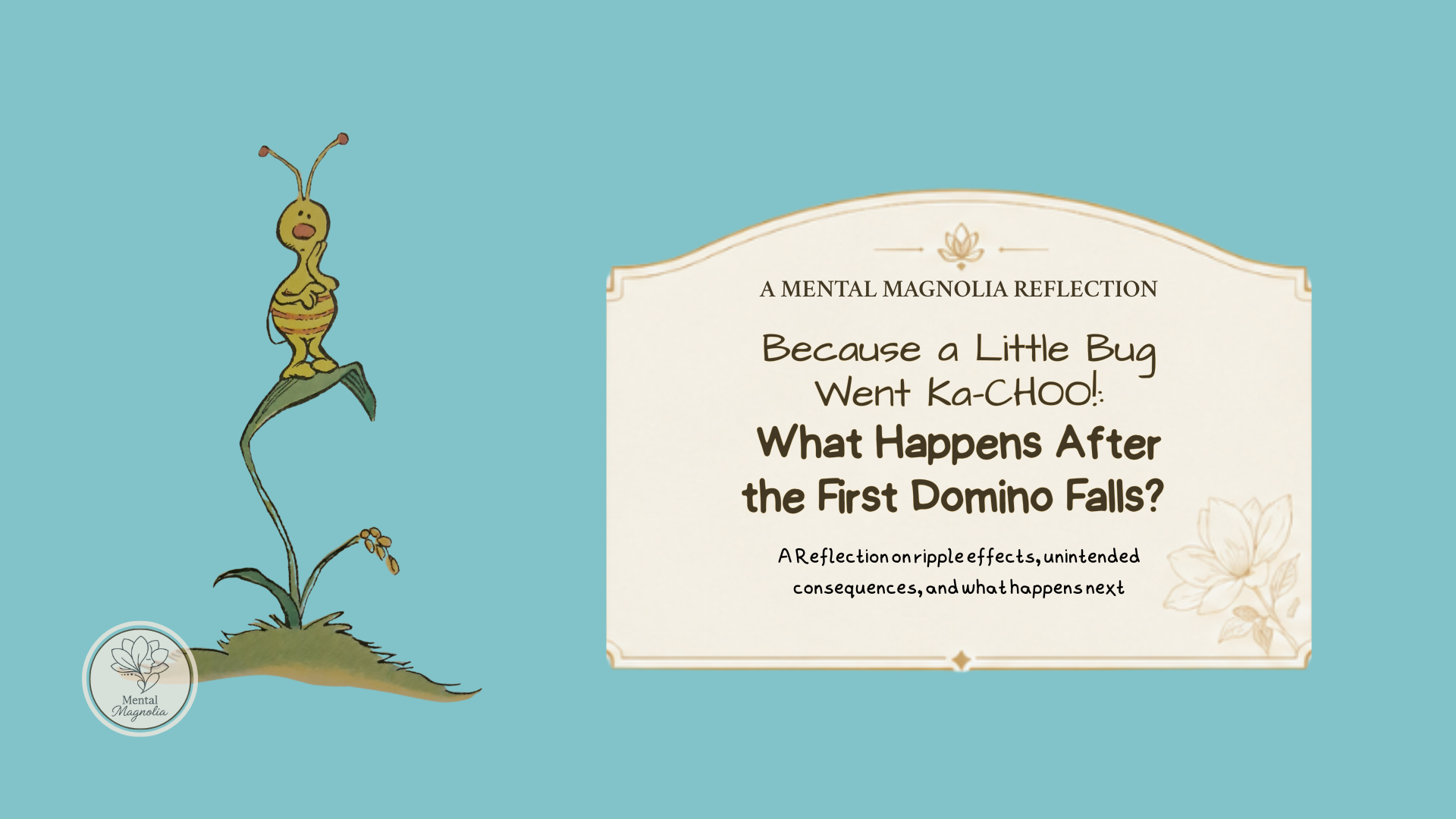
Some stories become more interesting when you revisit them as an adult. Because a Little Bug Went Ka-CHOO! is one of those stories for me.
I loved this book when I was a child. I grew up surrounded by Dr. Seuss books and the wonderfully strange worlds that came with them. Looking back now, I’m beginning to think Dr. Seuss and the larger Beginner Books universe may eventually need a Reflection of their own. There’s an astonishing amount of allegory, philosophy, psychology, and social observation hiding underneath all that rhyme, absurdity, and improbable transportation.
But right now this particular book has been sitting differently with me.
On the surface, it’s wonderfully ridiculous. A bug sneezes. A seed falls. One thing leads to another, then another, then another, until what began as one tiny involuntary event somehow ends in complete chaos.
Somewhere between the sneeze and the elephants carrying a boat through town, something much more interesting happens. Because the sneeze does not actually create all of that chaos on its own. People do. Or, in this case, worms and hens and turtles and farmers and police officers and boat passengers and helicopter crews and a steadily growing collection of very confused bystanders.
The sneeze simply begins the ripple. What happens next depends on what everyone does when that ripple reaches them.
The First Thing Wasn’t a Choice
The little bug sneezes. That part matters. He doesn’t wake up and decide to inconvenience everyone around him. He’s not reckless. He’s not malicious. He sneezes. Maybe he has a summer cold. Maybe a speck of something got where it didn’t belong. Whatever the reason, the sneeze is involuntary.
The vibration causes a seed to fall. Again, no villain yet. Cause meets effect. Motion travels. Gravity does what gravity does. Then the seed lands on a worm’s head. And for the first time, the story reaches a fork in the road.
The worm gets angry. Anger itself isn’t the problem. Anger can be useful. It can tell us that something hurt, frightened, frustrated, embarrassed, or threatened us. It can push us to protect ourselves, speak up, change something, or pay attention. But there is a difference between feeling anger and deciding what to do with it.
The worm does not pause to wonder what happened. He does not look up. He doesn’t ask where the seed came from. He simply sends his anger outward and kicks a tree. And now the ripple changes.
The original event may have been unavoidable. The next one was not.
What Reaches Us and What We Send Forward
The worm’s kick causes something else to fall, this time onto a turtle’s head. The turtle falls into the water. That part, again, isn’t much of a decision. Getting unexpectedly bonked on the head and losing your balance is less a philosophical choice and more a meeting between gravity and a very unfortunate turtle.
The splash reaches a hen. She gets wet. She gets angry. And once again, the story reaches a point where someone has a choice about what happens next. The hen kicks a bucket. More than likely, she doesn’t intend for that bucket to hurt anyone. That matters.
But intention doesn’t stop the bucket from landing on Farmer Brown’s head while he is still in bed. And there is one of the most important ideas hiding inside this absurd little story:
Intention does not erase consequences.
We don’t have to mean harm in order to affect someone. We don’t even have to know who will be affected. Sometimes we’re simply reacting to what reached us. But our reaction becomes part of someone else’s environment.
What we send outward doesn’t disappear when it leaves us. It becomes something another person now has to respond to.
The Ripple Keeps Finding New People
Farmer Brown wakes up with a bucket stuck on his head. His reaction is interesting because he does something different. He asks for help. Something happened to him that he cannot fix alone, so he communicates a need. That’s a response, too. Not every reaction in a chain has to escalate it.
Then help arrives and help creates its own complication. The police rush toward the problem. Presumably, they are trying to do the right thing. Their intention is good. But urgency, speed, and perhaps not quite enough attention create another accident.
One officer in a sidecar ends up separated from the motorcycle and crashes into a boat. Now the boat is sinking. People panic. More help is called. A helicopter arrives. The problem keeps growing.
At this point, nobody has decided, “I would like to create town-wide chaos today.” And yet they are all helping create it. That’s what makes ripple effects so difficult to recognize in real life.
By the time we see the final outcome, the original event may be several decisions, reactions, assumptions, accidents, and good intentions behind us. We look backward and say: That started it.
But starting something is not the same as being solely responsible for everything that followed.
We see the same thing in systems that seem completely unrelated to human behavior. Building a website can offer its own much less colorful version of the same lesson. One small problem in a piece of code can create an effect somewhere else entirely. Sometimes the original glitch is obvious. But sometimes everything appears fine until another piece of the site tries to interact with it. Then the symptom may appear far from where the actual problem began.
I was reminded of that again recently while dealing with a website issue. What looked like one isolated problem turned out to be another example of how interconnected systems behave: one small disruption can travel through relationships we don’t immediately see. And that’s the important part. The code does not have intentions. It’s simply connected.
Human systems are connected too, except we add emotion, interpretation, memory, assumptions, choices, and reactions to the equation.
Which means our ripples can become much harder to trace.
We Love Finding the Beginning
There’s something reassuring about identifying the first domino. If we can point to the beginning, we can tell ourselves we understand the ending. The bug sneezed. Therefore, the bug caused the chaos.
Except that explanation can ignore nearly everything that happened in between. In this case, it ignores the worm’s reaction. The hen’s reaction. The speeding response. The panic. The attempts to help. The people who became involved because someone else had become involved. The growing crowd. The choices. The accidents. The moments where the ripple could have changed direction.
The little bug is not the villain of this story. He sneezed. That’s all. Sometimes we do this to people, too.
We identify the person who said the first thing, made the first mistake, started the argument, asked the question, made the decision, or created the original problem. Then we trace everything that followed back to that single moment.
But a domino effect is not made of one domino. A chain reaction requires a chain. The original event may create the conditions.
What happens next is built along the way.
Then Everybody Starts Following the Boat
This may be the strangest part of the story. By the time the helicopter is carrying the damaged boat toward town, nearly everyone affected by the original chain reaction is following it. The bug. The worm. The turtle. The hen. Farmer Brown and his wife. The police officers. Other animals. Other people. More and more participants and onlookers join the procession.
And eventually a new question appears:
At what point does following the chaos stop being helpful and start becoming part of the chaos?
There may be good reasons to stay involved. Concern. Curiosity. Responsibility. A desire to make sure someone is okay. But attention and assistance are not always the same thing.
Sometimes we remain emotionally attached to an event long after our useful role in it has ended. Sometimes we keep passing it along. We retell it. React to it. Add our interpretation. Bring someone else into it. Choose a side. Watch the next development. Then the next. Then the next. And before long, the event has gathered people who were nowhere near the original moment.
We see this constantly online. Someone says something. Someone responds. Someone screenshots the response. Someone else comments on the screenshot. Another person adds context. Another removes it. Someone gets angry. Someone defends someone they’ve never met from someone else they’ve never met. More people arrive because everyone seems to be talking about it. And eventually, hundreds or thousands of people are emotionally participating in a chain of reactions that began somewhere else entirely.
Social media did not invent that human tendency. It simply gave the parade a much bigger Main Street.
Connection Does Not Mean Equal Responsibility
None of this means everyone in a chain is equally responsible for the outcome. They aren’t. Some events genuinely cannot be controlled. Some people have more information than others. Some have more power. Some are trying to help. Some are frightened. Some are hurt. Some make careless choices. Some are simply standing where the ripple happens to reach them.
Connection does not flatten responsibility. But it does mean that very few of us live entirely outside one another’s consequences.
Something happens to me. I interpret it. I feel something about it. I respond. My response reaches you. Now you interpret what reached you. You feel something. You respond. And the ripple continues.
Sometimes it becomes bigger. Sometimes it becomes distorted. Sometimes it becomes something the person who started it would not even recognize. It’s a little like the Telephone Game many of us played as kids. One sentence traveled around a circle, person to person, and by the time it reached the end, it was often barely recognizable. No one had to change it deliberately. The message simply passed through too many different ears, memories, assumptions, and interpretations.
And sometimes the distortion becomes the version everyone responds to.
The Moment Between Feeling and Acting
Maybe that is where the most useful question lives.
Not: How do I make sure nothing bad ever reaches me? We can’t.
Not: How do I control every consequence of everything I do? We can’t do that either.
We can’t predict every ripple. We can’t calculate every possible response. We can’t move through life terrified that one wrong word will eventually result in metaphorical elephants carrying a boat through town. But we can become more aware of the moment when something reaches us.
That small space between this happened to me and here is what I am going to send back into the world. Sometimes what reaches us deserves anger. Sometimes it deserves action. Sometimes it deserves help. Sometimes it deserves a boundary. Sometimes it deserves a question. Sometimes it deserves compassion. Sometimes it deserves nothing more than letting the ripple end with us.
The goal isn’t to eliminate reaction. The goal is to notice that a reaction is also an action, and once it leaves us, it may become part of someone else’s next choice.
The Universal Thread
We are connected whether we notice it or not. Our actions move through other people. So do our reactions. So does our silence. Our kindness. Our impatience. Our fear. Our assumptions. Our attempts to help. Our refusal to help. Our curiosity. Our anger. Our willingness to pause.
No one in the chain has to intend the final outcome to help create it. And no one person has to control the entire chain to change what happens next. Sometimes the ripple that reaches us is not ours to prevent.
But when choice exists, we can ask what we want to do with it. Do I absorb it? Pass it along? Make it larger? Redirect it? Investigate before reacting? Help? Step aside? Let it stop?
Maybe the most important question isn’t: Who started this?
Maybe it’s: What role am I playing in what happens next?
Reflection Prompts
When something unexpected reaches you, how quickly do you move from feeling to reacting?
Can you think of a time when your intention was good, but your impact was different from what you expected?
When have you joined a conflict, conversation, or situation after the original event had already passed through several other people?
How often do you look for the person who “started it” without examining the decisions that followed?
What ripple are you carrying right now, and what do you want to send forward?