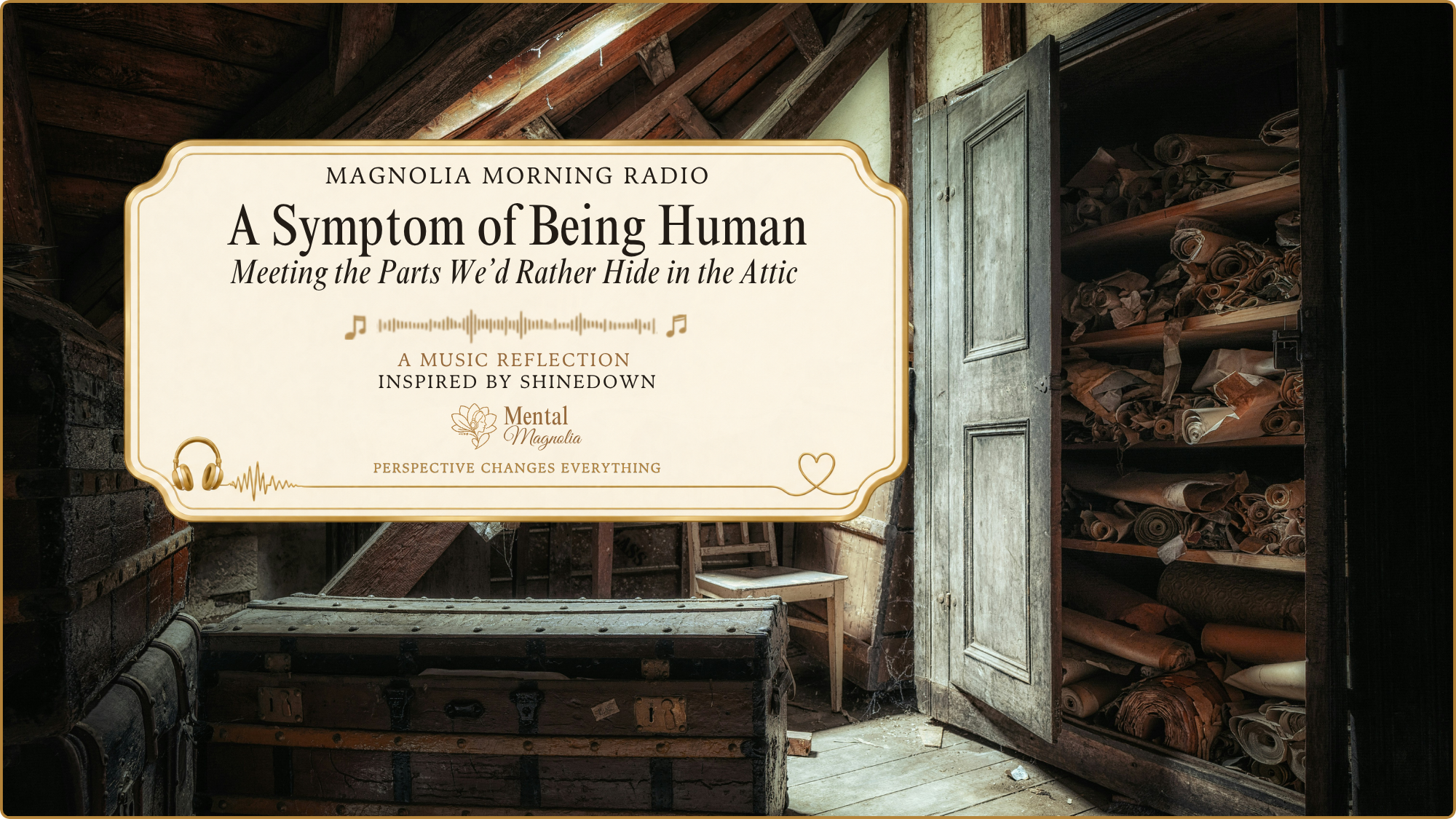
Meeting the Parts We’d Rather Hide in the Attic
There are parts of ourselves we display proudly. The qualities we like being associated with. The generous parts. The patient parts. The parts that make us feel like decent human beings.
And then there’s the attic.
Now Playing
Song: “A Symptom of Being Human”
Artist: Shinedown
Watch, then come back.
Unpack all your baggage
Hide it in the attic, where
You hope it disappears
This all seems so familiar
But it doesn’t feel like home
It’s just another unknown
That feels painfully accurate.
When something shows up in us that doesn’t match the version of ourselves we’re most comfortable with, our first instinct is often to put it somewhere. Jealousy. Resentment. Anger. Pettiness. Judgment. Selfishness. Fear. Need. Whatever makes us think, “Well, THAT wasn’t my finest moment.”
We don’t necessarily deal with it. We don’t always even look at it very closely. We shove it upstairs, shut the attic door, and hope eventually it stops making noise.
Except it usually doesn’t.
Part of the reason it feels so unsettling is exactly what the song says. It feels familiar, but it doesn’t feel like home. You recognize the feeling. You know it came from somewhere inside you, but it doesn’t fit neatly with the person you believe yourself to be. How many times do we say to ourselves:
“I’m not jealous.”
“I’m not selfish.”
“I’m not resentful.”
“I’m not somebody who thinks things like that.”
Yet… there it is.
There are parts of ourselves we tend to call monstrous. In reality, they’re just ordinary human things we’re uncomfortable admitting are ours. But here’s the important thing: if we don’t recognize those parts of ourselves, they can influence our choices without us even realizing it. Carl Jung called these hidden or rejected parts of the psyche the shadow, and much of his work explored what can happen when unconscious parts of ourselves remain outside our awareness.
There’s a quote often attributed to Jung and based on a section from one of his works:
“Until you make the unconscious conscious, it will direct your life, and you will call it fate.”
That starts with something surprisingly simple.
The Importance of Recognition.
Recognizing jealousy doesn’t mean jealousy defines you. Recognizing resentment doesn’t mean every resentment is justified. Recognizing anger doesn’t give you permission to hurt somebody. Recognizing a selfish impulse doesn’t mean you have to act on it.
Seeing something clearly isn’t the same as approving of it.
It’s just refusing to pretend it isn’t there. Maybe that becomes a little less frightening when we realize something else. Apparently, we’ve all been invited to the lunatic ball. Different baggage. Different attics. Different things rattling around upstairs. But nobody arrives entirely empty-handed.
That doesn’t erase responsibility for what we do with what we find. It does take away some of the shame of finding it. The uncomfortable thought, the ugly feeling, the reaction you wish you hadn’t had isn’t evidence that there’s some terrible creature hiding inside you. It’s simply evidence that there’s a human being in there.
If we can stop being quite so afraid of what we might find, maybe we can finally turn on the light and realize the shadows aren’t so scary after all.
Perspective:
What have you been trying to hide in the attic because you were afraid of what acknowledging it might say about you?