“We shape our tools and thereafter our tools shape us.”
— John Culkin
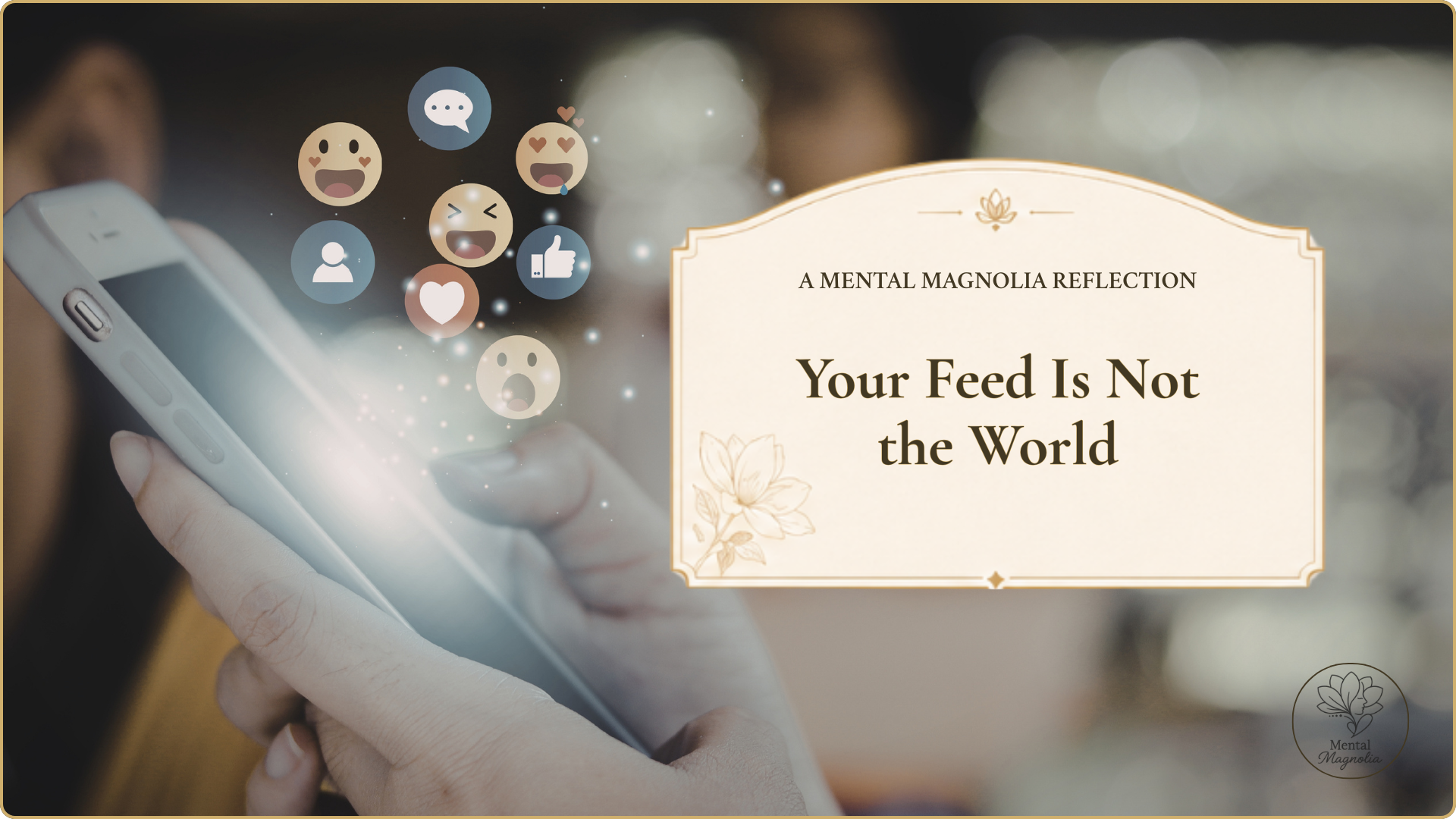
Watch one video about something. Pause on another. Search for something once. Maybe watch one particular kind of video all the way to the end, and suddenly your feed has reached a conclusion: Excellent. This is who you are now. 😂
So it gives you another one.
And another.
And another.
Some of that is useful. There’s more information available to us now than any human being could possibly sort through on their own, so it only makes sense that something has to decide what lands in front of us. The problem starts when we forget that something is deciding.
Not necessarily because somebody somewhere has personally decided what Cheryl should think on Wednesday afternoon. That would require an alarming amount of staff. 😜 But algorithms are designed to notice patterns. What we watch. What we skip. What we search for. What we like. What we share. What keeps us there a little longer.
We give the system clues. The system gives us more of what seems to work. We respond to that. It learns again. Round and round we go, and somewhere inside that loop, something interesting can begin to happen. Repetition starts feeling like prevalence.
What we see often starts feeling common. What feels common starts feeling normal. And what feels normal can very easily start feeling like the way things are. Except sometimes it’s just the way things are in our feed.
A viewpoint can appear overwhelming because we keep encountering it. A lifestyle can start looking ordinary because everyone being shown to us seems to live it. A standard of beauty, success, parenting, relationships, productivity, politics, spirituality, happiness, or anything else can begin looking universal when we are actually seeing a very carefully filtered slice of humanity.
The opposite happens, too. Something can be common in the real world and almost invisible in ours because we haven’t given the system any reason to show it to us. That doesn’t make the feed a lie. It makes it a frame.
And a frame can be true and still be incomplete.
The algorithm proved the point before we even started
I ran into this while working on this very week. I was looking for songs connected to the Beyond the Frame theme. And search after search kept bringing me back to the same familiar songs and the same heavily represented artists. There are thousands upon thousands of songs that could have carried pieces of this idea. But the same handful kept floating to the surface. It became almost comical.
I was trying to look beyond the frame, while the search system kept handing me the frame. 😂 That doesn’t mean someone deliberately buried every lesser-known song. It means systems tend to have stronger signals around things that are already well-known, frequently searched, heavily discussed, linked, watched, and indexed. And once something becomes easier to find, more people find it. Which gives the system even more evidence that people want to find it.
There’s our loop again.
So Mental Magnolia is running a little experiment
This week, I’m changing a few things about the way Mental Magnolia posts on social media. Not the message. Not the purpose. Just some of the signals surrounding it.
There are more short Quick Thoughts appearing between the regular posts. I’m experimenting with current trends and discovery signals where they legitimately fit. And I’m watching what happens when similar kinds of ideas are packaged and introduced to the platforms in slightly different ways.
The point is not to become whatever the algorithm wants. Quite the opposite. I want to see how much the algorithm affects who gets the opportunity to see something in the first place. Same Mental Magnolia. Same weird little constellation brain behind it. 😜 Just different signals. Different conditions. Then we watch.
This is not peer-reviewed research. Nobody has issued me a lab coat. I’m also well aware that one week of social-media numbers won’t prove how the entire internet works. But it might give us something interesting to notice.
Because this isn’t only about trying to get posts seen. It’s about all of us trying to understand the world while looking at it more and more through systems that are learning how to hold our attention.
And we are part of the loop
It would be easy to put all of this at the feet of technology companies. They built the systems. They make money when we stay. Attention has value. That deserves scrutiny. But there’s another uncomfortable little piece of this: We willingly participate.
We click.
We watch.
We react.
We share the thing that makes us furious.
We stop on the thing that confirms what we already suspected.
We sometimes scroll straight past something unfamiliar because understanding it would take more effort than recognizing it.
Every one of those choices is tiny. Together, they teach the machine. And then the machine hands our choices back to us. Louder.
That’s why John Culkin’s line feels so remarkably current nearly sixty years later:
We shape our tools, and thereafter our tools shape us.
So what do we do?
We probably don’t need to throw our phones into a lake. Which is fortunate – they’re expensive. We can simply remember what the feed actually is. It’s a selection. It’s a recommendation. It’s a prediction.
It is a frame.
Not the world.
Maybe every once in a while we search for something the algorithm didn’t suggest. Listen to the song that wasn’t at the top. Read past the first result in a Google search. Hear an opinion without preparing the rebuttal before listening to the whole argument. Talk to actual, real people. Ask what isn’t being shown. Notice when “everyone thinks this” really means everyone I’m currently being shown thinks this. And maybe notice when the version of life we’re comparing ourselves to exists mostly because we’ve watched enough of it to convince a machine we’d like some more.
That counts as self-care, too. Because sometimes taking care of ourselves means refusing to measure our lives against a world that has been filtered specifically to keep our attention. And caring for each other may require remembering that none of us fits neatly inside the version of humanity showing up on somebody else’s screen.
There is always more beyond the frame.
Look again. The world is bigger than your feed.