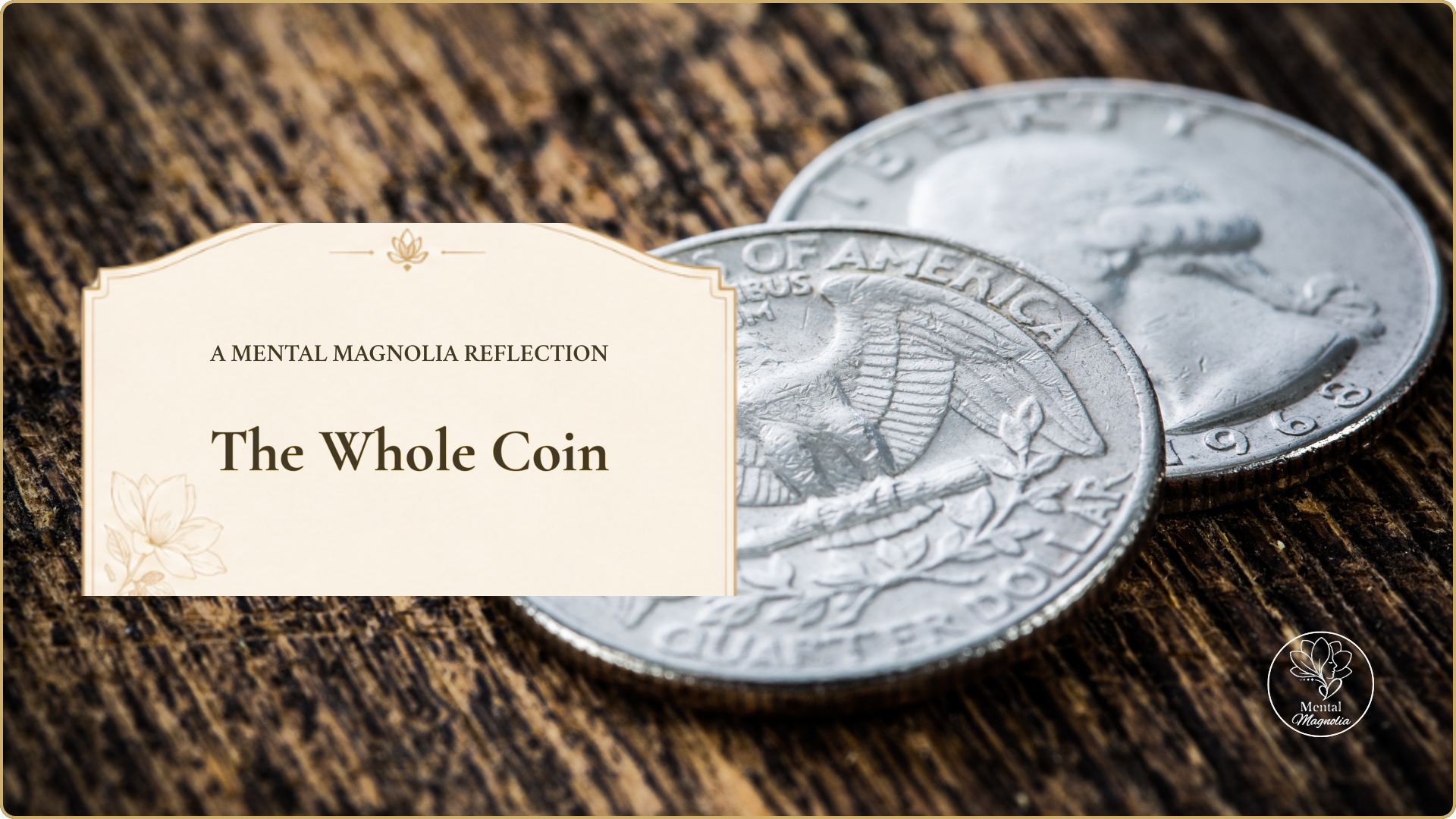
Hold up a quarter. One side is heads. Flip it over. The other is tails. Two different images. Two different sides. Both completely real. If I’m looking at heads and tell you what I see, I’m telling the truth. If you’re looking at tails and describe something completely different, you’re telling the truth, too. Neither of us has the whole view.
I’ve spent a lot of this week talking about that. The picture inside our frame can be real without being complete. The version of someone we know can be real without being the whole person. The experience we had can be completely valid without canceling someone else’s very different experience of the same thing.
Sometimes two things that seem to oppose each other aren’t actually asking us to choose between them. Sometimes they belong to the same coin. That idea is much older than social media, algorithms, or any of the other frames I’ve shared about this week.
The Tao Te Ching puts it this way:
“Being and non-being create each other,
difficult and easy complete each other,
long and short contrast each other,
high and low lean on each other.”
Not erase each other. Not defeat each other. Complete each other.
There’s something in that worth sitting with. Because we humans really do love an either/or.
Happy or sad.
Strong or vulnerable.
Hopeful or realistic.
Independent or connected.
Take care of yourself or take care of somebody else.
Good experience or bad experience.
Right or wrong.
Heads or tails.
It makes things easier to sort. Life, unfortunately, has never shown much interest in staying properly sorted. You can love someone deeply and still need space from them. You can be grateful for your life and exhausted by parts of it. You can know you made the right decision and still grieve what it cost. You can be incredibly strong and need help. You can have a wonderful day that also contained something painful. You can disagree with someone and still care about them. You can recognize what is difficult without making difficulty the only thing you see.
Two things can be true at the same time. F. Scott Fitzgerald once wrote:
“The test of a first-rate intelligence is the ability to hold two opposed ideas in mind at the same time and still retain the ability to function.”
Maybe part of the challenge isn’t figuring out which side of every coin we’re supposed to choose. Maybe it’s learning to hold the whole thing.
What happens when the quarter spins?
Set that quarter on its edge and spin it. Heads. Tails. Heads. Tails. Faster and faster until your eyes can’t neatly separate the two anymore. The individual sides haven’t disappeared. They’re still there. But suddenly you’re seeing something different. Not one side winning. Not one side becoming more true than the other.
You’re seeing the whole object in motion.
And in my head, that spinning quarter keeps becoming something larger. A sphere. A world. Not literally, of course. A quarter remains stubbornly quarter-shaped despite my philosophical ambitions for it. 😄 But as an image, it works. One world. Countless sides. Different people standing in different places, carrying different histories, looking from different angles, seeing different pieces.
Still part of the same whole.
And that brings me to one of the most familiar lines in the Bible:
“Love your neighbor as yourself.”
— Mark 12:31 NIV
I’ve heard that verse most of my life. But lately one little word in it keeps getting bigger. As. Love your neighbor as yourself. Not instead of yourself. Not after you’ve completely erased yourself. Not only when your neighbor thinks the way you do. And not only after you’ve decided they deserve it.
As yourself.
There’s a kind of balance built right into the sentence: self and neighbor. Inward care and outward care. Neither one requires the destruction of the other. That matters because we tend to turn caring into another either/or.
If I take a little time to put myself first, am I being selfish?
If I give too much to everyone else, where did I go?
If I love someone, do I have to always agree with them?
If I disagree, does that mean I no longer care?
If their experience is different from mine, does that mean one of us have to be wrong?
Maybe not. Maybe heads doesn’t have to become tails. Maybe tails doesn’t have to prove heads is false. Maybe they simply belong to the same quarter.
Connection does not require sameness.
I think we’ve confused connection with agreement more than we realize. Agreement can certainly make connection easier. So can shared experiences, shared beliefs, shared language, shared culture, shared expectations. But sameness is not the only thing that connects us.
Sometimes connection begins when we stop demanding sameness. It looks alot like when I can say, “This is what I see from here,” and still leave enough room to ask, “What can you see from there? That doesn’t require giving up on the idea of truth. It doesn’t require pretending every interpretation is equally accurate. It doesn’t require abandoning personal values or agreeing with everything another person believes.
It simply requires enough humility to remember that none of us stands everywhere at once. We see from somewhere – always. Through our history, our culture, our wounds, our hopes, our experiences, our feeds, our families, our expectations, our fears, our faith, our questions.Though our particular side of the quarter.
Sometimes the most useful thing we can do is stop insisting that our side must be the whole view.
The Universal Thread
This is where I keep finding myself lately. In the space between things we usually separate:
Self and neighbor.
Joy and grief.
Strength and vulnerability.
Difference and connection.
The difficult and the beautiful.
Not because those things are secretly identical. They aren’t. Sometimes not even close. Heads is still heads. Tails is still tails. But they belong to something larger than either side can show on its own.
Maybe that’s part of what I mean when I talk about a Universal Thread. Not that we all have to believe the same things. Not that every difference disappears if we squint hard enough. Not that pain becomes good simply because something good can exist beside it. Just that underneath all of our categories, perspectives, stories, roles, and arguments, there may be more connection than we usually remember to look for.
The Taoist sees complementary forces. Fitzgerald describes the ability to hold opposing ideas. Jesus puts self and neighbor inside the same commandment. Different languages. Different traditions. Different frames. Yet all three leave me standing in roughly the same place, looking at the same quarter held in my hand.
Maybe balance isn’t choosing the right side. Maybe it’s learning to see the whole. To acknowledge the difficult without allowing it to swallow the beautiful. To appreciate the beautiful without pretending the difficult isn’t there. To care for ourselves without forgetting one another. To love one another without demanding that we become the same. To know that what we see matters while remembering that there may always be more beyond our view.
Heads.
Tails.
One coin.
Different perspectives.
One world.
Connection does not require sameness. It may only ask us to keep ourselves open to something else.
Because remember… Perspective changes everything. 😉